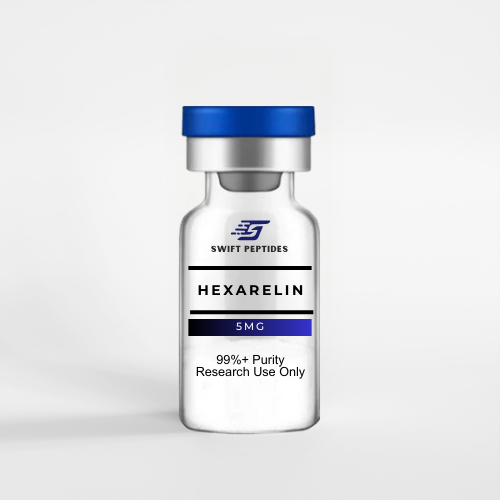
Description
What Hexarelin Acetate Is (Overview)
Hexarelin Acetate is a synthetic growth hormone–releasing peptide (GHRP) and a potent ghrelin receptor (GHS-R1a) agonist. It is studied for its ability to stimulate endogenous growth hormone (GH) release through neuroendocrine signaling.
Hexarelin is considered one of the stronger GHRPs in research due to its robust GH-releasing activity.
How Hexarelin Works (Mechanism of Action)
Hexarelin binds to the growth hormone secretagogue receptor (GHS-R1a) in the:
-
Hypothalamus
-
Anterior pituitary
Activation of this receptor:
-
Triggers rapid GH release from the pituitary
-
Operates independently of GHRH
-
Can synergize with GHRH analogs in research models
Because it mimics ghrelin signaling, Hexarelin engages both GH release pathways and appetite-related signaling.
Key Effects Observed in Research
📈 Potent Growth Hormone Release
🧠 Neuroendocrine Pathway Activation
❤️ Cardiovascular Signaling Interest
🍽️ Appetite-Related Signaling
How Hexarelin Differs From Other GH-Related Compounds
Key distinctions:
-
❌ Not exogenous growth hormone
-
❌ Not a GHRH analog (like Sermorelin)
-
❌ Not selective for GH only — engages broader ghrelin signaling
Compared to milder GHRPs, Hexarelin is often described as more aggressive in GH stimulation, making it useful for high-signal research models.